
The Journey of Cats: From Ancient Hunters to Beloved Companions
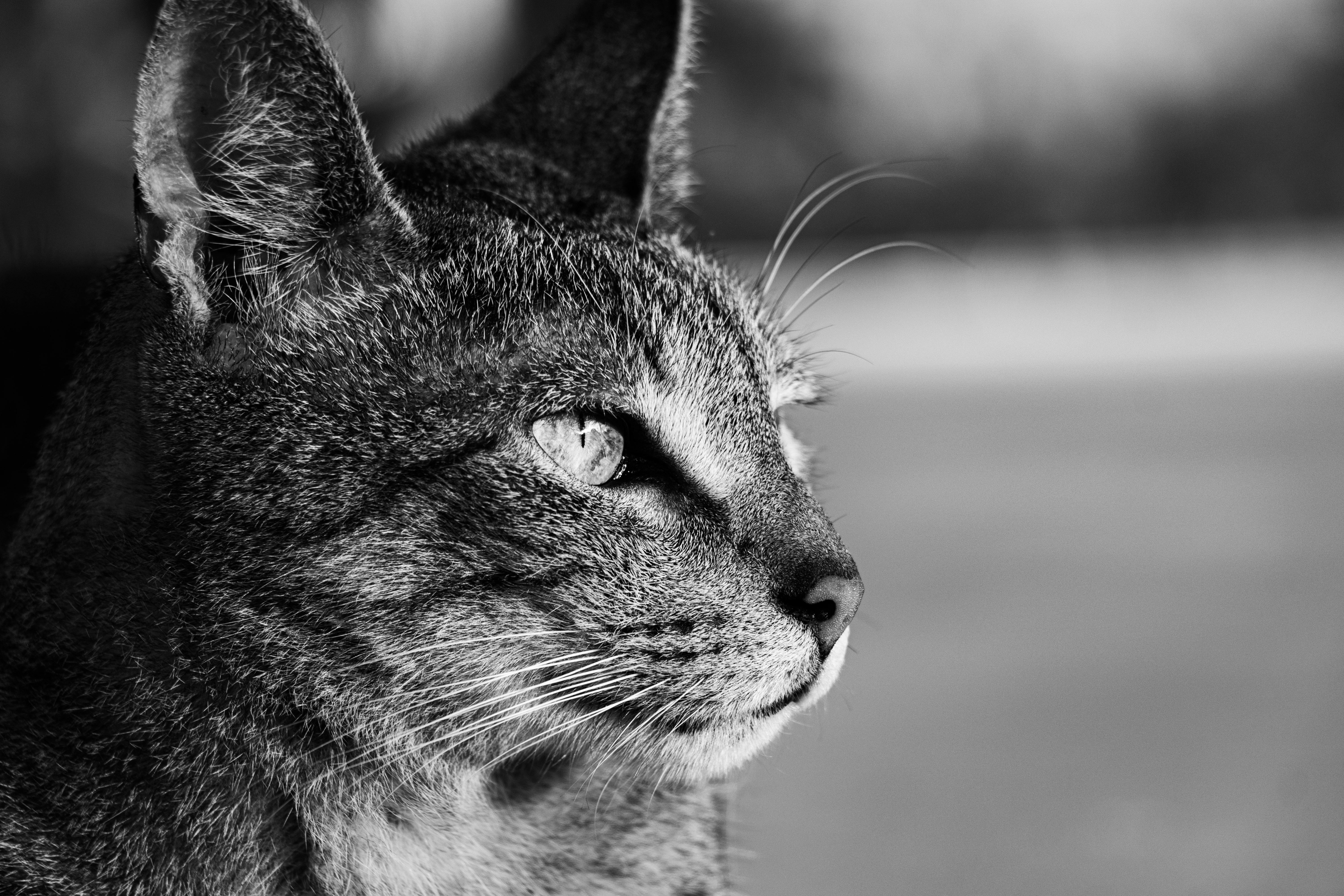
Right now, somewhere in the world, a cat is sitting in a sunlit window watching the world with complete indifference. It has been doing exactly this for 10,000 years.
Cats hold a strange kind of power over us. They curl up on our couches, knock things off shelves without apology, and somehow still make us feel lucky that they chose to stay. But the cat sitting beside you right now carries a story far older and wilder than the life it lives today. It is a story of ancient deserts, forgotten civilizations, ocean voyages, religious worship, and a slow, quiet trust built between two species who never quite planned to find each other. This is that story.
Evolutionary Roots of the Cat
The domestic cat (Felis catus) is the only fully domesticated member of the family Felidae, a group that also includes lions, tigers, and cheetahs. Its direct ancestor is the African wildcat (Felis lybica lybica), a lean, sandy-colored hunter native to North Africa and the Middle East. A landmark 2007 genetic study published in Science analyzed DNA from nearly 1,000 cats worldwide and traced every domestic cat alive today back to this single lineage. A 2025 follow-up study, also published in Science, used full genome sequencing on 87 ancient and modern cats and refined that picture further, confirming North Africa as the central region where domestication took hold and spread.
There are five wildcat subspecies across the world: European wildcats, Central Asian wildcats, Southern African wildcats, Chinese desert cats, and the African wildcat. So why did only the African wildcat become the one that walked toward humans? The answer comes down to geography and temperament. The African wildcat already lived near the dry, grain-friendly landscapes where early farming first took root. Compared to its cousins, it was also slightly more tolerant of proximity to other animals. That small behavioral difference, almost invisible at first, turned out to be the most consequential trait in cat history.

Photo Credit: Leonemanuel (Wikipedia)
Physically and genetically, the African wildcat and your house cat are nearly identical. Domestication left only minor genetic changes, mostly tied to behavior, coat patterns, and tolerance of humans. The underlying biology remained almost untouched. A cat’s eyes contain a reflective layer called the tapetum lucidum, allowing them to see in light six times dimmer than what humans require. Their ears can rotate 180 degrees and detect frequencies up to 64,000 Hz, well beyond what humans or dogs can hear. Their whiskers are precision instruments sensitive enough to detect shifts in air current. None of this changed during domestication.
A few things did change. Domestic cats have slightly shorter legs, a modestly smaller brain, and a longer intestine than their wild ancestors, an adaptation Charles Darwin noted, likely connected to scavenging human food scraps over thousands of years. These are subtle differences. Underneath, the animal is still a hunter.
That hunting instinct is where the evolutionary story gets complicated. A well-fed house cat that has never needed to hunt will still stalk a shadow, ambush a toy, or kill a bird it has no intention of eating. That behavior is not learned. It is hardwired at a level domestication has not reached. In the context of human homes, it reads as playful. In ecosystems where cats have been introduced, the same instinct has driven dozens of species to extinction. The cat that charmed its way into human civilization carried its predatory biology with it, unchanged, into every corner of the world it eventually reached.
(Ref: The Near Eastern Origin of Cat Domestication – Driscoll et al., Science, 2007 | Dispersal of Domestic Cats from North Africa to Europe – Ottoni et al., Science, 2025)
First Encounters: Cats and Agriculture (~10,000 years ago)
When humans in the Fertile Crescent shifted from nomadic life to settled farming, they began storing grain. Stored grain attracted rodents, and rodents attracted wildcats. Cats bold enough to venture near human settlements had access to dense, reliable prey. Over generations, the bolder cats thrived near humans while more fearful ones stayed away. No one trapped them or bred them deliberately. The relationship started as pure pragmatism on both sides.
This is what makes cats unlike every other domesticated animal. Dogs, cattle, sheep, and goats were all brought into human life through deliberate effort. Humans selected them, confined them, and bred them for specific purposes. With cats, the process ran the other way. The cat assessed the situation, found it favorable, and moved closer on its own terms. Humans tolerated them because they were useful. Biologists sometimes describe this as self-domestication, and the archaeological record supports it. There is no evidence anywhere of humans actively trapping or selectively breeding wildcats in this early period. The cat let itself in.
The clearest early evidence of this bond was found at a burial site in Shillourokambos, Cyprus, dating to around 9,500 years ago. Archaeologists uncovered the skeleton of a 30-year-old human buried with rich offerings: polished stone axes, flint tools, sea shells, and ochre. Less than half a meter away, in a separate pit dug at the same depth and at the same time, lay the complete skeleton of an 8-month-old wildcat. The bones were articulated, meaning the animal had been buried whole and with care. No signs of butchering. No signs of a meal. Just a cat, placed beside someone of clear social importance, oriented in the same direction, treated with the same deliberate intention.
Since cats are not native to Cyprus, someone carried that animal across open water on purpose. That single detail matters. This was not a stray that wandered into a grave. It was transported, and then buried with ceremony beside a person who mattered in their community. That grave, 9,500 years old, tells you the relationship had already moved well beyond convenience, long before Egypt, long before Bastet, long before any of the stories we usually tell about cats and humans.
What that grave does not tell you is what came after. The same qualities that made cats valuable to early farmers, their hunting efficiency, their ability to thrive in human environments, their rapid reproduction, would eventually make them one of the most ecologically disruptive animals on the planet once humans began carrying them beyond their native range. That part of the story came much later. But it started here, in a grain store somewhere in the ancient Middle East, with a wildcat that decided to stay.
(Ref: The Near Eastern Origin of Cat Domestication – Driscoll et al., Science, 2007 | Oldest Known Pet Cat, 9,500-Year-Old Burial – National Geographic)
Cats in Ancient Civilizations
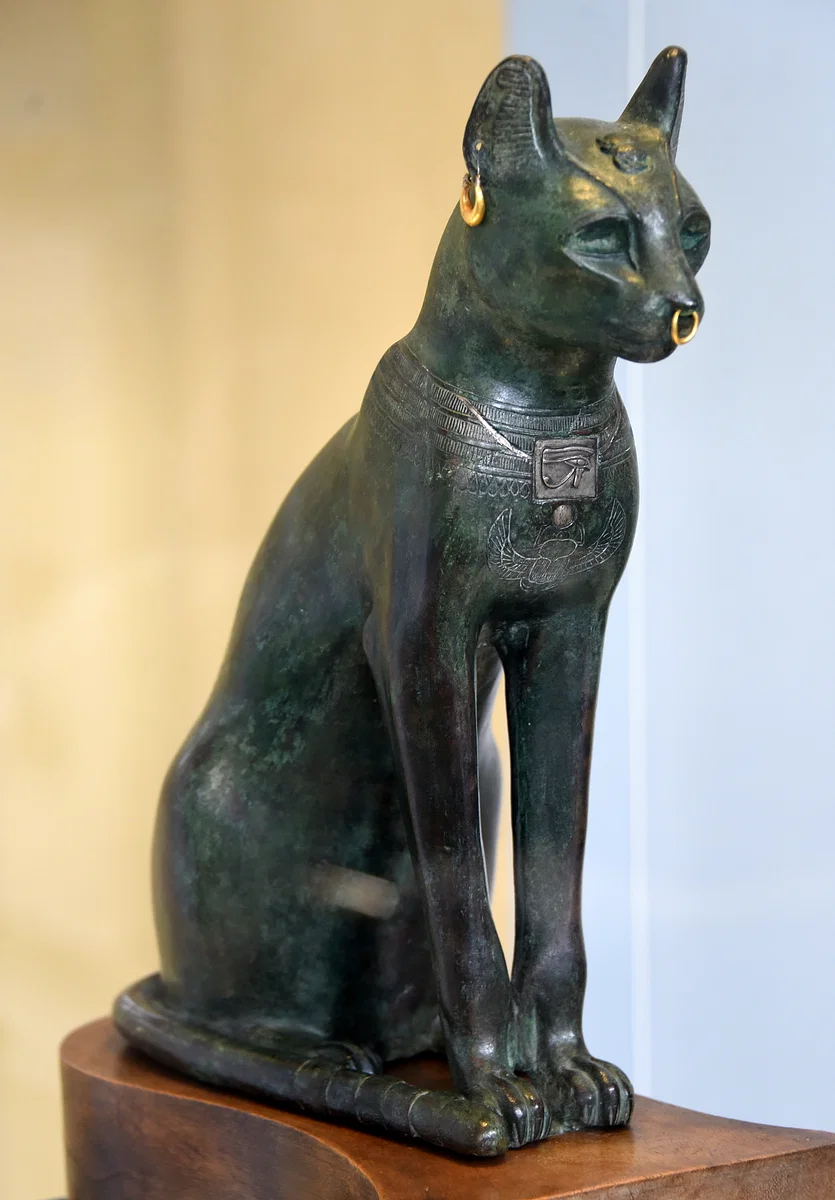
Photo Credit: Osama Shukir Muhammed Amin
1. Egypt: Sacred Protectors (~4900 years ago)
No civilization in the ancient world built a deeper relationship with cats than Egypt, and that relationship has two distinct chapters separated by roughly 1,300 years.
The first chapter begins around 2890 BCE, roughly 4,900 years ago, during the Second Dynasty, when Egyptians first connected cats to the goddess Bastet. In that early form she appeared as a lioness, fierce and solar, associated with the protective and destructive power of the sun. This was not yet about the domestic cat. It was about what the cat represented: controlled danger, vigilance, and divine protection.
The second chapter begins around 3,600 years ago, during the New Kingdom period, when Egyptian paintings first showed cats sitting beneath chairs, collared and tethered, eating from bowls beside their owners. These are the oldest unmistakable depictions of fully domestic cats anywhere in the historical record. By this point the cat had moved from religious symbol into daily household life, and Bastet’s image had shifted with it. By around 900 BCE she had fully transformed from lioness into a seated cat wearing golden jewelry, calm and watchful. Her sacred city of Bubastis became a center of organized cat worship, and the number of cat mummies found there, measured in tons, shows that Egyptians were actively breeding cats at scale. It is the earliest recorded instance of deliberate cat breeding in history.
The reverence shaped daily life in concrete ways. Killing a cat, even accidentally, carried severe legal punishment. Herodotus, writing in the 5th century BCE, recorded that Egyptians would run into burning buildings to save their cats before saving their possessions. When a household cat died, the family shaved their eyebrows as a sign of mourning and kept vigil until the grief period passed. Thousands of cat mummies have been found in tombs, many buried with jewelry, food offerings, and small bronze statuettes.
The Gayer-Anderson Cat, now in the British Museum in London, is one of the finest surviving objects from this period. Cast in bronze between 664 and 332 BCE, it shows a seated cat wearing a golden nose ring and a scarab pendant. Its posture is composed and still. It is not a crude religious token. It is a work of care and precision that tells you exactly how much this animal meant to the people who made it.
Egypt eventually banned the export of cats, treating them as a national asset. The ban proved impossible to hold. By around 2,500 years ago, cats had moved into Greece through Mediterranean trade networks, carrying with them the cultural weight of a civilization that had treated them as sacred for over a thousand years.
(Ref: World History Encyclopedia – Cats in the Ancient World | The Taming of the Cat – Driscoll et al., Scientific American, 2009)
2. Greece and Rome: Utility and Symbolism (Around 2,500 to 2,000 years ago)
By around 2,500 years ago, cats had made their way into Greece through the same Mediterranean trade networks that moved grain, pottery, and dye between Egypt and the broader ancient world. Egypt had tried to restrict their export for decades, but trade routes are difficult to police, and cats, useful on ships and in warehouses, moved with cargo whether officially permitted or not.
In Greece, cats held no religious significance. They were not elevated to sacred status the way they had been in Egypt, and they appear in Greek mythology only in passing. What they offered was strictly practical: they kept rodents out of grain stores, homes, and farms. That was enough to make them welcome wherever food was stored. A mosaic from the House of the Faun in Pompeii, dated to the late 2nd century BCE, shows a cat gripping a quail, a small hunting scene preserved in tile that reflects how familiar cats had become in Mediterranean households by that point.
Rome is where the spread accelerated. For a long time historians assumed cats had reached mainland Europe through earlier Greek and Phoenician trade. The 2025 genome study published in Science overturned that assumption. Full genome analysis confirmed that the oldest ancestral domestic cat remains on mainland Europe date to the 1st century CE, during the early Roman Empire, not centuries earlier as previously believed. It was Roman military expansion, not earlier trade, that carried cats deep into Europe. Researchers confirmed this by identifying feline remains at Roman military sites in Austria, Serbia, and Britain, all genetically linked to modern domestic cats. Wherever Roman soldiers built a garrison and stored grain, cats arrived.
The Latin word felis, from which the scientific name Felis catus is derived, was the everyday Roman term for cat. It appeared in Roman texts with the casual familiarity of an animal nobody thought twice about anymore. By the time Mount Vesuvius buried Pompeii in 79 CE, cats were already a common presence across the empire, from North Africa to Britain.
That spread carried consequences nobody considered at the time. Britain was an island with its own established balance of predators and prey. Cats arriving with Roman garrisons entered that ecosystem without any native species having evolved defenses against them. The disruption was modest by later standards. But Rome had set the pattern: human expansion carrying cats into places they did not naturally belong. That pattern would repeat itself at a far greater scale when European ships began crossing oceans fifteen centuries later.
(Ref: World History Encyclopedia – Cats in the Ancient World | Dispersal of Domestic Cats from North Africa to Europe – Ottoni et al., Science, 2025)
3. Asia: Fortune, Folklore, and Silk (Around 2,000 to 1,400 years ago)
Cats reached Asia in stages, moving east along the same trade corridors that carried silk, spices, and Buddhist manuscripts between civilizations. The timeline differs by region, and the cultures they entered shaped them into something far more mythologically rich than anything they had encountered in Egypt or Rome.
China (~1,400 years ago)
China’s cat history involves two separate animals that are easy to confuse. The leopard cat, a native wild species, had been living near Chinese human settlements for at least 5,000 years. Archaeological evidence shows leopard cat bones at Neolithic farming sites, and some earlier researchers interpreted this as evidence of independent cat domestication in China, parallel to what happened in the Fertile Crescent.
The 2025 Cell Genomics study, which analyzed ancient feline bones from 14 Chinese archaeological sites using DNA rather than bone shape alone, drew a sharper conclusion. The leopard cats that lived near early Chinese farming communities were never fully domesticated. They exploited human settlements the same way wildcats initially did in the Middle East, by hunting the rodents that gathered around grain stores, but the relationship never crossed into domestication. They remained wild animals living at the edge of human space.
Fully domestic cats, carrying Middle Eastern genetic lineages, arrived in China around 1,400 years ago during the Tang Dynasty, brought by Silk Road merchants. This distinction matters because it separates two things that often get merged in popular histories: an animal living near humans, and an animal that has genuinely entered into the human domestic sphere. The leopard cat did the first. It never did the second.
In Chinese mythology, a cat figure named Li Shou appears in traditional stories as a deity connected to farming and crop protection. A well-known folk story describes cats being placed in charge of the newly created world, repeatedly neglecting their duties in favor of sleeping and playing, and eventually suggesting that humans seemed better suited for the task. The gods gave humans speech and placed them in charge. The cats went back to doing very little. Whether the myth developed around the leopard cat that was already present or arrived later alongside the domestic cat is unclear, but the agricultural connection in the story aligns closely with what the archaeology shows: in China, the cat’s relationship with humans began in the grain store, just as it had 8,000 years earlier in the Fertile Crescent.
(Ref: Leopard Cats Occupied Human Settlements in China Before Domestic Cats – Cell Genomics, 2025 | All About Cats – Stanley Medical Research Institute)
Japan (~2,000 years ago)
Japan’s cat history is older than traditionally assumed. The standard account placed their arrival during the Nara period, roughly 1,200 to 1,300 years ago, brought on ships to protect Buddhist scrolls from rats. But in 2011, cat bones excavated at the Karakami ruins on Iki Island in Nagasaki Prefecture were identified as belonging to the Yayoi period, pushing the earliest confirmed evidence back to around 2,000 years ago. Iki Island sits between Japan and the Korean Peninsula and was an active trading hub during the Yayoi period, which makes it a plausible early entry point for cats arriving from continental Asia.
Once established, cats became economically vital during the Edo period, guarding silk farms from the rats that threatened one of Japan’s most important exports. Records from that period show a cat could fetch five times the price of a horse at the height of the silk trade. Japanese folklore gave cats a reach far beyond economics. The bakeneko and nekomata are supernatural cats capable of walking on two legs, speaking human language, and wielding spiritual power. They appear in hundreds of regional legends across the country, shifting between protector and predator depending on how they were treated by the humans around them.
The Maneki Neko, the beckoning cat figurine found in shops and homes across Japan, became popular during the Edo period, though its exact origin is genuinely disputed and no single story is accepted as definitive. One of the most well-known accounts is connected to Gōtokuji temple in Tokyo. A feudal lord named Ii Naotaka was leading a hawking party when the head monk’s cat beckoned to him from the temple gate. He followed the cat inside. Shortly after, a violent thunderstorm struck. Ii credited the cat with saving him, adopted the temple under his family’s patronage, and it prospered. The raised paw of the Maneki Neko is said to trace back to that gesture of beckoning, though other origin stories exist and the true source remains unclear.
Japan’s smaller island chains tell a harder part of the story. On islands where bird species had evolved with limited exposure to mammalian predators, cats that escaped domestic settings found prey with few natural defenses against them. The folklore celebrated the cat. The isolated island ecosystems bore a cost the folklore did not record.
(Ref: Waneko Studies: A Journey into Japan’s Cat Lore – Nippon.com)
4. Turkey and the Islamic World (~1,400 years ago)
Cats found a more consistently welcoming reception in the Islamic world than almost anywhere else in history. While medieval Europe was burning cats as symbols of witchcraft, Muslim communities across the Middle East, North Africa, and Central Asia were feeding them, housing them in mosques, and treating their presence as both practically useful and spiritually appropriate.
The theological foundation is more specific than most accounts suggest. The verified hadith recorded in Sunan Abu Dawood (75) and Al-Tirmidhi (92) quotes the Prophet Muhammad directly: “They are not impure; they are among those who go around among you.” That ruling had immediate practical consequences. It meant cats could move freely through mosques, homes, and prayer spaces without making anything ritually unclean, a status no other animal shared in the same way. One of the Prophet’s closest companions was nicknamed Abu Hurayra, meaning Father of the Kitten, because of his constant companionship with a small cat he carried with him. The nickname was given by Muhammad himself, which tells you something about how the relationship between the Prophet and cats was understood by those around him.
A widely told story describes Muhammad cutting off the sleeve of his robe rather than disturbing a cat sleeping on it before prayer. This account has circulated across fourteen centuries and continues to shape how cats are understood in Islamic culture. It is worth noting that the story does not appear in the most rigorously authenticated hadith collections, and some Islamic scholars regard it as a later tradition rather than a verified historical record. The ritual purity ruling, by contrast, is firmly established.
That religious foundation aligned naturally with something cats already offered: cleanliness. Cats groom obsessively, avoid soiling their living spaces, and carry none of the associations with filth that dogs carried in classical Islamic jurisprudence. In a tradition that places significant weight on ritual purity, the cat fit almost perfectly.
In Ottoman Turkey this cultural respect became institutional. Charitable foundations called vakıfs funded the feeding and care of street cats around mosques and public spaces. This was not informal kindness. It was organized, budgeted, and maintained as a civic responsibility alongside the upkeep of roads and water supplies. The Ottoman city did not merely tolerate its street cats. It built systems around them.
Istanbul today is the most visible living example of that history. Thousands of cats move freely through its streets, fed by residents, welcomed into cafes and shops, and treated as a natural part of urban life. The 2016 documentary Kedi followed several of Istanbul’s street cats and the people who care for them, and reached audiences across the world because something in that relationship felt both ancient and immediate.
It is worth noting that Istanbul’s tolerance of street cats does not resolve the ecological questions that free-roaming cat populations raise everywhere. Urban cats in Istanbul, as in other cities, kill birds and small urban wildlife. The cultural framework that protects them sits in genuine tension with conservation concerns that are becoming harder to ignore as urban wildlife research matures.
(Ref: Islam and Cats – Wikipedia | Cats Considered Pure Throughout Muslim History – Ynetnews | World History Encyclopedia – Cats in the Ancient World)

Photo Credit: reddit
5. Arrival of Cats in India (~2,000 years ago)
Domestic cats most likely reached India around 2,000 years ago, arriving through the same trade corridors that connected the Mediterranean world to South Asia. Merchants moving between Egypt, Persia, and the Indian subcontinent crossed both overland Silk Road routes and Indian Ocean sea lanes. Cats were practical cargo on those journeys: they controlled the rats that threatened stored grain and trade goods in ship holds and port warehouses. Over time they settled into trading cities and agricultural communities, becoming familiar animals in households and markets without any single moment of deliberate introduction.
The archaeological evidence for exactly when cats arrived in India remains thinner than in Egypt or Rome. What fills that gap is literary evidence, and it is surprisingly rich. Cats appear in several of the oldest surviving works of Indian literature, suggesting they were already well known animals in the cultural imagination long before they became common household companions.
In the Mahabharata, one of the two great Sanskrit epics, a passage describes the cat Lomasa and the mouse Palita forming a temporary alliance to escape a shared threat, a story built around the tension between predator and prey and what happens when survival forces unlikely cooperation. In the Ramayana, the god Indra disguises himself as a cat while fleeing the consequences of his encounter with Ahalya. That a major deity would choose a cat as a disguise suggests the animal was already familiar enough to pass unnoticed in an everyday setting.
The Panchatantra, a collection of instructional fables compiled roughly 2,000 to 2,300 years ago, returns to cats repeatedly, almost always casting them as clever manipulators who use the appearance of piety to deceive smaller animals. One of the most well known stories describes a cat standing in a river with eyes closed and paws raised, pretending to be a holy ascetic, while luring mice close enough to catch them one by one. It is a sharp portrait of predatory deception dressed in the language of moral instruction. These fables traveled through Persian and Arabic translations into the Middle East and eventually into European literature, carrying the cat’s reputation as a cunning and not entirely trustworthy creature across several continents.
In religious symbolism, the goddess Shashthi is traditionally depicted riding a cat, linking the animal to fertility, safe childbirth, and the protection of children. This association placed cats within the domestic and sacred sphere of the home in a way that went beyond simple utility.
The widespread modern belief in India that a black cat crossing your path signals bad luck does not appear to have deep roots in classical Indian tradition. Historians trace it to medieval European folklore that arrived during the colonial period and gradually merged with existing local superstitions. In older rural communities across the subcontinent, a healthy cat in the household was more commonly read as a sign of protection and good fortune, not a warning.
What India also shows is how cats adapted to dense, complex human environments far from their original desert habitat. The same animal that hunted rodents in Fertile Crescent grain stores was, within a few thousand years, riding a goddess, outwitting mice in Sanskrit fables, and settling into the rhythms of one of the most populated regions on earth. That adaptability, celebrated in the literature, is the same quality that makes feral cat populations so difficult to manage in the subcontinent today.
(Ref: The Evolution of House Cats – Driscoll et al., Scientific American, 2009 | World History Encyclopedia – Cats in the Ancient World)
Medieval Europe: Revered and Reviled (~1,000 years ago)
Cats never fully lost their usefulness in medieval Europe. Farms, monasteries, granaries, and ships all relied on them to control rodents, and that practical value kept them alive even as their cultural reputation collapsed around them. The medieval cat existed in two worlds at once: essential to the people who depended on grain storage, and increasingly suspicious to a Church that was looking for symbols of heresy and demonic association.
The shift began gradually. By the 11th century, cats in parts of Europe were being associated with nocturnal wickedness, partly because of their reflective eyes, their silence, and their habit of moving through darkness without apparent fear. In 1233, Pope Gregory IX issued a papal document that explicitly linked black cats to Satanic worship, describing them as instruments of the devil in heretical rituals. That decree gave theological weight to a fear that had already been building, and in several regions it accelerated into organized violence. Cats were killed during religious festivals, burned publicly as symbols of evil, and in some towns, cat burning became an annual ceremony repeated over centuries.
It is worth being precise about the plague connection, because the blog version of this history is often oversimplified. The claim that cat persecution caused the Black Death by reducing the rodent-hunting population is a compelling story but a disputed one. The bubonic plague is caused by the bacterium Yersinia pestis, carried primarily by fleas on rats. While fewer cats theoretically meant more rats, the actual dynamics of the 14th century plague outbreak involved trade routes, poor sanitation, and flea transmission in ways that make a direct line from cat persecution to pandemic mortality very difficult to establish. Most historians of medieval disease treat the cat-plague connection as a plausible contributing factor at best, not a cause. The plague would have spread with or without the cats.
What is less disputed is that cats continued to be kept wherever they were needed most. Monastery records across England, France, and Germany show cats being fed and maintained as working animals throughout the medieval period, even as Church doctrine grew more hostile. English law under Edward II in the 14th century required all vessels to carry a cat for pest control. The practical world and the theological world operated on separate tracks, and cats survived by staying useful.
The rehabilitation began in the 18th century, driven by three forces arriving at roughly the same time. Belief in witchcraft declined as Enlightenment thinking spread across educated Europe. A new wave of brown rats, more aggressive and prolific than the black rats they replaced, made cats more valuable in cities than they had been in generations. And as Louis Pasteur’s work on microbes became widely known, cleanliness became associated with health, and the cat, already famous for its obsessive grooming, benefited from that association directly. A creature that had been burned as a servant of the devil was quietly reframed as a symbol of domestic hygiene.
(Ref: World History Encyclopedia – Cats in the Ancient World | A Brief History of House Cats – Smithsonian Magazine | All About Cats – Stanley Medical Research Institute)
The Age of Exploration: Cats Go Global (~500 years ago)
By the time European ships began crossing oceans in the late 15th century, cats had already spent thousands of years proving their value at sea. They controlled the rats that chewed through rope, spoiled food stores, and spread disease on voyages that could last months without sight of land. Every major seafaring culture, from ancient Egyptian grain ships to Roman trading vessels to Viking longships, had carried cats as working crew. By the Age of Exploration, putting a cat on a ship was not a decision anyone thought twice about. It was simply what you did.
Christopher Columbus reportedly carried cats on his Atlantic crossings. The Mayflower brought them to North America. The settlement at Jamestown records cats among its earliest imports, valued for keeping the rat population under control in a colony that could not afford to lose its food stores. By the 1500s and 1600s, cats were arriving at ports on nearly every continent, traveling with Portuguese, Spanish, Dutch, and British ships along trade routes that connected Europe to the Americas, West Africa, South Asia, and the Pacific.
Sailors built their own folklore around cats during this period. Black cats, feared and persecuted on land across much of Europe, were considered good luck at sea. Some sailors believed a cat licking its fur against the grain signaled an approaching storm. Others refused to sail on any vessel that did not carry one. The ship’s cat had become a maritime institution, somewhere between working animal and talisman.
Australia’s cat history sits in a zone of genuine historical uncertainty. Some researchers, including the team behind the 2009 Scientific American study, place the first European cats in Australia in the 1600s, arriving with Dutch and British explorers. Other sources attribute the main wave of introduction to British colonial settlement beginning in the late 18th century. DNA analysis of Australian cats confirms they are of European origin rather than Asian, but the precise timing remains debated. What is not debated is what happened next.
When cats arrived in Australia, New Zealand, and remote Pacific islands, they entered ecosystems that had evolved for millions of years without a mammalian predator of their kind. Native birds had no instinct to flee a stalking cat. Ground-nesting species had no behavioral defenses against a hunter that could move silently through grass. Native mammals had no evolutionary experience of anything that hunted the way a cat hunts. Cats bred rapidly, spread into wilderness, and went feral in environments that had no answer for them.
The scale of that impact is not a minor footnote. Studies published in the journal Biological Conservation estimate that cats have contributed to the extinction of at least 63 vertebrate species globally, including 40 birds, 21 mammals, and 2 reptiles. In Australia alone, feral cats occupy nearly the entire continent and are listed as a key threatening process under national environmental law. They kill an estimated 1.4 billion native animals every year in Australia, a figure that includes mammals, birds, and reptiles that exist nowhere else on earth.
The sailors who loaded cats onto their ships were solving a real problem. They were not thinking about Stephens Island wrens or bilbies or kakapos, because those places and creatures were beyond their horizon entirely. But the decision to carry cats across oceans, repeated thousands of times over two centuries of exploration, set in motion an ecological disruption that is still being measured and still being debated today.
(Ref: Dispersal of Domestic Cats Traced Through Ancient DNA – PNAS | The Evolution of House Cats – Scientific American, 2009 | Cats as Invasive Species – Biological Conservation)
The Modern Era: From Mousers to Companions
The Enlightenment did not set out to rehabilitate the cat. It set out to replace superstition with observation, and the cat simply benefited from that shift. As educated Europeans began looking at the natural world with curiosity rather than fear, the cat’s grace, independence, and hunting precision became things to admire rather than suspect. Writers and philosophers began keeping cats. Artists painted them. The creature that had been burned in public ceremonies two centuries earlier was quietly becoming a symbol of refinement.
By the Victorian era the transformation was complete in Britain. Queen Victoria kept two Persian cats at Windsor Castle, which was all the cultural signal the country needed. Within years, cats appeared in the homes of the middle class, in the fiction of Charles Dickens, in the poetry of Tennyson, and in the illustrations of popular magazines. The cat’s aloofness, once read as sinister, was now reframed as dignity. Its independence, once associated with witchcraft, was reread as aristocratic self-possession.
Then came 1871. The first formal cat show opened at Crystal Palace in London, organized by artist and cat enthusiast Harrison Weir, who believed cats deserved to be judged and celebrated the way dogs had been for decades. Thousands of people attended. Persian, Siamese, and Manx cats were displayed as living works of art. For many visitors it was the first time they had seen cats as something to admire and collect rather than simply keep. Selective breeding began in earnest. New coat patterns, new body shapes, new eye colors were developed deliberately, the first time in the entire history of the human-cat relationship that humans were actively shaping what cats looked like rather than the other way around.
The early 20th century brought cats into working class homes across Europe and North America, but the animal that lived in those homes was still largely an outdoor creature, expected to earn its keep hunting rodents. The shift toward the fully indoor companion cat happened in stages. In 1947 an American businessmen named Edward Lowe began selling an absorbent clay product he called Kitty Litter, solving the single biggest practical barrier to keeping cats entirely indoors. Within a decade, indoor cat keeping became genuinely viable for the first time in 10,000 years of cat history. Cat ownership in the United States grew by 50 percent between 1989 and 2006 alone.
Following World War II, cats spread into regions where they had previously been rare or absent. Arctic communities in Alaska reported cat ownership by the 1970s. In the Soviet Union, keeping pets had been officially discouraged under Mao-era ideology in China as bourgeois behavior. After 1976, pet keeping gradually became acceptable, and cat ownership in Chinese cities grew rapidly through the 1990s and 2000s. Today China is one of the largest cat-owning nations on earth.
The internet arrived and did something nobody predicted. Cats became the unofficial language of human tenderness online. The first viral cat video is generally traced to 2006. By the early 2010s, cat content was among the most shared media on the internet, crossing language barriers, age groups, and cultures in a way that no other animal has managed. Researchers have studied why, and the leading explanations center on the same features that made wildcats approachable 10,000 years ago: large eyes, rounded faces, and small bodies that trigger the same nurturing response humans have toward infants. The cat did not change. The screen just gave it a new surface to sit on.
What mass pet keeping also brought, and what rarely appears in the warm framing of cat ownership statistics, is a global feral crisis. Every surge in cat ownership produces a corresponding surge in abandonment. Every abandoned cat that survives outdoors becomes a potential founding member of a feral colony. The same period that saw kitty litter normalize indoor cats also saw feral populations grow to an estimated 480 million animals worldwide. The modern era gave the cat its most comfortable chapter in history. It also created the largest unmanaged population of a single invasive predator the world has ever seen.
(Ref: The Cat Fanciers Association – History of Cat Shows | All About Cats – Stanley Medical Research Institute | The Taming of the Cat – Scientific American, 2009)
Cat Communication
One of the most fascinating things about cats is something most people never think about: cats almost never meow at other cats. Watch two cats interact. They hiss, they chirp, they trill, they use body language and scent. But the meow, the sound we most associate with cats, is used almost exclusively with humans.
The reason goes deeper than most people realize. Kittens use a high-pitched mew to get attention from their mother. By four to five months of age, they stop mewing at other cats entirely. But they never stopped directing that sound at us. The adult meow is essentially a kitten behavior that cats kept alive specifically for humans, a sound they learned works on us and never let go of. Scientists have identified up to 21 distinct cat vocalizations, but the meow is the one that evolved almost entirely around the human relationship.
Over thousands of years of living alongside us, cats also learned to modulate how they meow depending on what they need. A meow can be assertive, friendly, demanding, or plaintive. Some cats have even learned to produce a silent meow, opening their mouths without making any sound at all, and somehow this tends to work even better on humans. Researchers at Sussex University found that cats embed a higher-frequency cry within their purrs when they want food, making the sound more urgent and harder to ignore. The frequency is similar to that of a crying infant. It is not an accident. It is 10,000 years of cats learning how to talk to us in a language we cannot quite refuse.
A cat that lives with you long enough will develop a private vocabulary, sounds it uses with you that it uses with no one else. There is also the chirrup, a rolling trill that mother cats use to call their kittens, which adult cats redirect toward humans and other cats as a friendly greeting. You can actually mimic it back and your cat will often respond. And then there is the chattering, that strange clicking sound cats make when watching a bird through a window. Researchers believe this may mimic the sounds of prey, a remnant hunting strategy from long before cats ever shared a couch with anyone. They are, in the most literal sense, still carrying the wild inside them, even while learning new ways to talk to us.(Ref: Wikipedia – Cat Communication )
Cats and Human Health
The relationship between cats and human health turns out to be more than emotional. It is measurable.
Multiple studies have found that cat ownership is associated with a significantly reduced risk of heart attack and stroke. A 10-year study from the University of Minnesota found that people who had never owned a cat were 40 percent more likely to die of a cardiovascular event than those who had. Researchers believe the stress-reducing effect of living with a cat, the lowered cortisol levels, the slower heart rate, the simple comfort of something warm and alive nearby, accumulates into real biological benefit over time.
Then there is the purr. A cat’s purr falls between 25 and 50 Hz, which is the same frequency range used in medical vibration therapy to promote bone density and accelerate healing. Some researchers have suggested that living with a purring cat may contribute to stronger bones over time. Whether or not that holds up to further study, what is already clear is that the sound of a cat purring is not just pleasant. It is physiologically calming in a way that science is only beginning to fully understand.
Cats are also used in therapeutic settings with elderly patients, children with autism, and people recovering from trauma. Their independence, the fact that they do not demand anything from you, makes them uniquely suited for people who feel overwhelmed by expectation. A cat will sit beside you without asking you to be okay.
The Ecological Cost of a Perfect Predator
The same evolution that made cats useful to humans made them dangerous to every ecosystem they were introduced into. These two facts are inseparable, and any honest account of cat history has to hold both of them at the same time.
Cats are, by any biological measure, extraordinarily effective predators. They hunt using sight, sound, and smell simultaneously. They can detect movement at distances that most prey animals cannot register as threatening. They stalk in near silence, accelerate without warning, and kill with a precision bite to the back of the skull that requires no learned technique. These traits evolved over millions of years in the ecosystems of North Africa and the Middle East, where prey animals had corresponding defenses built over the same timeframe. The predator and the prey evolved together. That balance does not exist anywhere cats were introduced by humans.
The International Union for Conservation of Nature lists the domestic cat among the 100 worst invasive species in the world. That designation is not based on sentiment. It is based on a consistent, replicated body of research spanning multiple continents and decades.
A landmark 2013 study published in Nature Communications by Loss, Will, and Marra estimated that free-ranging cats kill between 1.3 and 4 billion birds and between 6.3 and 22.3 billion mammals annually in the United States alone. Those numbers are not dominated by feral cats, as is commonly assumed. The study found that owned cats allowed outdoors contributed meaningfully to that total. A well-fed cat with a full bowl at home will still hunt. Hunting in cats is not driven by hunger. It is a hardwired behavioral sequence that food does not switch off. Numerous studies have confirmed that satiation does not reduce hunting frequency in domestic cats.
On islands, where the consequences are sharpest, the data is unambiguous. Research published in PLOS ONE found that cats have been implicated in the extinction of at least 63 vertebrate species globally, representing 26 percent of all bird, mammal, and reptile extinctions recorded since 1500. Island species are disproportionately represented because they evolved in isolation from mammalian predators and carry no instinct to flee or avoid a stalking cat.
The Stephens Island Wren extinction in New Zealand, which occurred around 1894, is the most documented single case. A lighthouse keeper’s cat named Tibbles hunted a small flightless bird that had survived on that island for thousands of years without ever encountering a mammalian predator. The species was gone within roughly a year. What makes the Tibbles case significant is not its uniqueness but its clarity. It is a single, traceable line between one introduced cat and one species extinction. Across dozens of other islands, the same process played out with more cats and more species but less precise documentation.
Australia represents the most severe ongoing case. Feral cats now occupy virtually the entire Australian continent. A 2017 study published in Biological Conservation estimated that Australia’s feral cat population kills approximately 1.4 billion native animals annually, including mammals, birds, and reptiles found nowhere else on earth. The Australian government classifies feral cats as a key threatening process under national environmental law and has implemented lethal control programs in protected areas, a policy that generates significant public controversy but reflects the scientific consensus on the scale of the problem.
It is also worth separating two different arguments that often get conflated in this debate. The first is whether cats cause ecological harm. On that question, the scientific evidence is extensive and consistent: they do, at a scale that is difficult to overstate in regions where they are not native. The second is what to do about it. On that question, there is genuine disagreement between ecologists, animal welfare advocates, and conservationists, and no consensus solution has emerged. Trap-Neuter-Return programs reduce colony growth over time but do not eliminate hunting by existing cats. Lethal control is effective but contested. Mandatory containment of pet cats reduces individual impact but is poorly enforced almost everywhere it has been attempted.
The cat did not choose to be carried to Australia or New Zealand or the Pacific Islands. That responsibility belongs entirely to humans. But acknowledging that fact does not change what happens once a cat is there. Evolution built this animal to hunt, and 10,000 years of living beside humans has not meaningfully changed that.
(Ref: Loss et al., Free-Ranging Domestic Cats Kill Billions of US Wildlife Annually – Nature Communications, 2013 | Cats as Invasive Species – IUCN Invasive Species Specialist Group | Doherty et al., Invasive Predators and Global Biodiversity Loss – PNAS, 2016)
Feral Cats Today
Alongside an estimated 600 million domestic cats worldwide, there are somewhere between 480 million and 600 million feral cats living entirely outside human homes. The uncertainty in that range reflects how difficult feral cat populations are to count: they avoid humans, move across large territories, and reproduce faster than most monitoring programs can track. What is not uncertain is the trajectory. Left unmanaged, a single pair of cats can produce hundreds of descendants within five years. Feral populations, once established, grow rapidly and are extraordinarily difficult to reduce.
Feral cats exist on every continent except Antarctica. They occupy city alleyways, agricultural land, coastal scrub, tropical islands, and the edges of wilderness reserves. In urban environments they form loose colonies with recognizable social hierarchies. In rural and island environments they often live as solitary hunters, covering large territories and exerting sustained predation pressure on whatever wildlife is available.
The TNR Debate
Trap-Neuter-Return, in which feral cats are caught, sterilized, vaccinated, and released back into their territory, is the most widely practiced feral cat management method globally, particularly in urban areas. Proponents point to studies showing that consistent TNR programs can stabilize and gradually reduce colony sizes over periods of five to ten years in contained urban environments, provided that immigration of new cats into the colony is controlled and the program is sustained without interruption.
The scientific literature on TNR is considerably more mixed than its advocates typically acknowledge. A 2003 study published in the Journal of the American Veterinary Medical Association found that even in a well-managed TNR program at the University of Central Florida, the cat population did not meaningfully decline over eleven years, largely because of ongoing abandonment of new cats into the managed area. A 2011 review published in Conservation Biology concluded that TNR is “not an effective tool to protect wildlife” and that it fails to reduce feral populations at the landscape scale needed to address biodiversity impacts.
The core problem is that TNR addresses reproduction but does not address predation. A neutered feral cat continues to hunt at the same rate as an intact one. Sterilization changes reproductive output, not behavior. In areas with vulnerable wildlife, particularly islands or reserves with threatened species, neutered feral cats cause the same ecological damage as unneutered ones.
Colony feeding, practiced by volunteers as part of most TNR programs, adds another layer of complexity. Research has consistently shown that supplemental feeding does not reduce hunting frequency in cats. It does, however, support higher cat densities than the local prey base alone could sustain, concentrating predation pressure on wildlife in and around feeding sites. A 2020 study in the journal Animal Conservation found that fed feral cats in urban areas killed significantly more wildlife per individual than unfed feral cats, because better-fed cats had more energy available for active hunting.
What the Science Actually Says
There is no scientific consensus that TNR alone can resolve feral cat impacts at a population scale. The American Bird Conservancy, the Wildlife Society, and numerous conservation biology organizations have published position statements opposing TNR as a primary management tool in areas with wildlife conservation concerns. Their position is not that cat welfare is unimportant but that the current evidence does not support TNR as a sufficient response to the ecological problem feral cats represent.
Lethal control, including targeted culling in ecologically sensitive areas, has demonstrated effectiveness in reducing feral cat populations and allowing native wildlife to recover. New Zealand’s predator-free conservation programs, which include cat control alongside rat and stoat management, have produced documented recoveries of threatened bird species on managed islands. Australia operates sanctuaries enclosed by cat-proof fencing where native mammal populations have recovered significantly after cat removal. These results are real, but the methods are deeply controversial with the public and with animal welfare organizations.
The tension between cat welfare and wildlife conservation is genuine and unresolved. Both concerns are grounded in evidence. What the science does not support is the position that the problem can be managed humanely without any reduction in the number of free-roaming cats. Population stabilization through TNR is not the same as population reduction, and population reduction is what wildlife impact studies consistently show is necessary.
The Human Responsibility
Every feral cat alive today is descended from a domestic cat that was abandoned, lost, or allowed to breed without control. The global feral population is not a wildlife phenomenon. It is the accumulated result of human decisions made across centuries, from the sailors who carried cats to islands with no native predators, to the pet owners who abandon animals they can no longer care for, to the policies that have consistently prioritized the comfort of cat advocates over the survival of threatened species.
That is not an argument for cruelty toward cats. It is an argument for honesty about what the feral cat problem is, where it came from, and what scale of response the evidence actually demands.
(Ref: Loss et al., Free-Ranging Domestic Cats Kill Billions of US Wildlife Annually – Nature Communications, 2013 | Longcore et al., Critical Assessment of Claims Regarding Management of Feral Cats by TNR – Conservation Biology, 2009 | Doherty et al., Invasive Predators and Global Biodiversity Loss – PNAS, 2016)
How Will Cats Evolve
The cat has already done something no other animal quite managed. Without being tamed, without being forced, it walked out of the African wilderness and negotiated its own place in human civilization. It bent just enough to live beside us while keeping everything that made it wild. That balance, held for 10,000 years, is probably the most remarkable thing about the domestic cat.
Where it goes from here is genuinely unknown. Urban feral populations may evolve broader diets and more scavenging behavior as cities expand. Domestic breeds will continue to be shaped by human preference, growing more varied in appearance while staying, underneath, almost identical to the African wildcat that started all of this. If climate change reshapes ecosystems dramatically enough, wild cat relatives may face serious pressure, and the domestic cat may find itself filling ecological roles no one intended for it.
But the more interesting question is a quieter one. After 10,000 years of living beside us, are cats still evolving toward us? Some researchers think so. Cats in close human contact are showing gradual increases in the social behaviors that humans respond to: more eye contact, more vocalization, more tolerance of touch. The negotiation, it seems, is still ongoing.
The cat in your home right now is the product of 10,000 years of that conversation. It carries the hunting instincts of a desert wildcat, the cultural weight of Egyptian temples and Japanese folklore and Viking ships, and whatever quiet understanding it has built with you specifically, in this house, in this life. It will sit in a sunlit window and watch the world with complete indifference. And somehow, that will be enough.
Author of the Article

Meet Gori
Volunteer, Secure Nature Society.